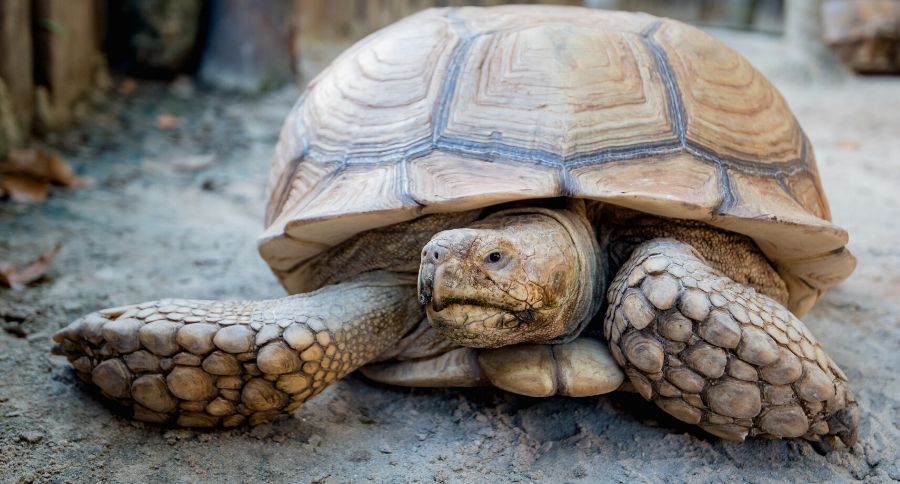
Don't be fooled. These are huge tortoises. There is also a lot of controversy over owning one as a pet.
Buzz Feed News shares that the males can grow to over 200 pounds.
"Like"teacup" pigbuyers, prospective sulcata owners are often burdened with significant misinformation. Pet stores sometimes tell customers that the animals stay small if kept in a small tank (they don't), that they can eat anything vegetarian (they can't), and that if they get too big, a zoo will take them (a myth that zookeepers are sick of debunking). Even kept with the best intentions, sulcatas might develop deformed shells, or tear up drywall and backyards."
Make sure you have all the facts before considering a Sulcata Tortoise. During an interview with an expert, Buzz Feed News confirms they're difficult large pets to live with.
"They're just pretty destructive. Any place you see a wall, there's some reason with a sulcata," Susan Tellem, American Tortoise Rescue's co-founder, explained as she showed me a deep hole Tank had dug recently.
"Which is not to say that the sweet and friendly animals never make good pets. Tellem calls them "hard dogs," and Tank (her sulcata) comes when he's called. "They're personable, they're entertaining, they know their names," Tellem said. "People don't realize how smart they are."
Sulcatas are among the most-bred tortoises and are the third-largest species of tortoise in the world.
Behavior and diet
The Spruce Pets tells us that they're quiet!
"Sulcata tortoises are big and slow. They can easily get stuck in spaces that are too small for them, flip themselves over and be unable to right themselves. They need hot temperatures to stay healthy and active. Many people cannot meet the demands of a full-grown sulcata for such a long stretch and end up trying to re-home the animal once it reaches adulthood."
They are pleasant and docile, rarely aggressive and not very territorial.
What about diet? This reminds me of our neighbor's horse!
Sulcatas graze and forage for hours during the day. Their diet consists of grasses and hay on which to graze. This is the bulk of their diet. Greens and veggies should be about 10 to 15 percent of their diet.
Greens to offer include collard greens, kale, mustard, turnip, and dandelion greens. Limit greens that are high in oxalates, such as parsley, spinach, rhubarb, beet greens, and collard greens.
Fruit should be a treat only and you'll need to talk to your vet about a multivitamin.
Housing a Salcata Tortoise
Given the size of this tortoise indoor housing isn't recommended unless the weather is an issue. An outdoor heated greenhouse is a great alternative.
Housing isn't low maintenance as this large tortoise needs a ton of space.
MedVet For Pets recommends the following when you're planning outdoor housing:
- They must be provided a dry, heating housing unit to which they will return to at night and during inclement weather. If they will not go in and out of this housing on their own, they need to be physically moved.
- Daytime temperatures during much of the year should range from 85F-105 F during the day. At night, temperatures can drop into the 70s F in their enclosure.
- It is recommended that fencing not be see-through, as many owners report their sulcatas trying to climb or push over these barriers to get to the other side.
- Sulcatas enjoy burrowing so they should be provided material in which to dig and burrow. Ideas for burrowing material include hay, leaves, grasses or straw.
- Sulcatas need to be kept dry. Provisions need to be taken to keep their enclosure free of damp materials and excess moisture.
- A shallow water bowl, with sides low enough for the tortoise to reach into, should be available at all times if there is no wallow available. Tortoises do not swim and can drown easily. You need to make sure they can easily access the water but that it is not any deeper than the tortoise's bridge, the section of the shell that joins the carapace (top shell) and plastron (bottom shell).
If you must live with one then choose one from a reputable breeder.
There are many factors to consider like tortoise diet, potential health problems, tortoise food, the water dish, nighttime temperatures, grass hay, outdoor enclosure and if you live in a region with a rainy season.
Frankly, it sounds like the best fit would be if you live in the Sahara desert!
What is the age of the oldest pet you've ever lived with? Please leave us a comment below!
WATCH NOW: Why Pets Are the Best
Love reading about pets?
Don't miss a story! Sign up for daily stories delivered to your inbox.