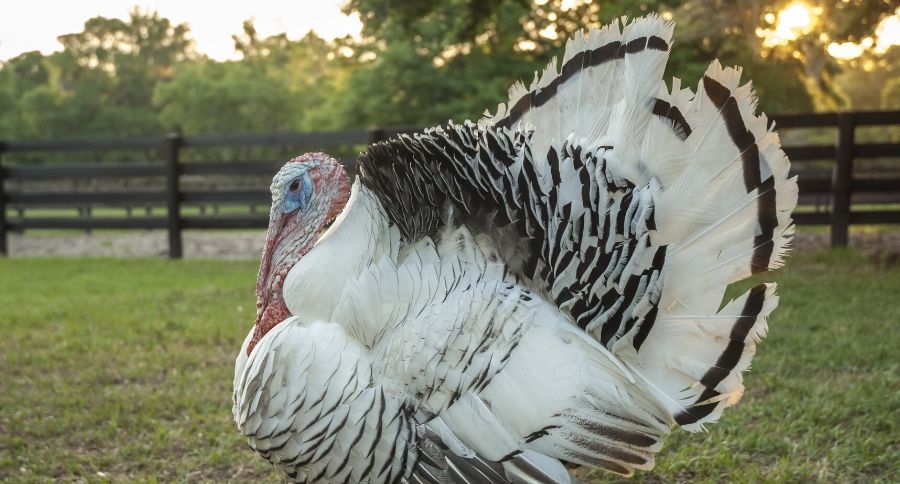
The Royal Palm turkeys are active, thrifty and excellent foragers. They are also very good flyers.
Another interesting fact about these birds is they are one of the few turkeys which are not primarily raised for meat production. It is best known as an ornamental breed with a unique appearance. The breed is mainly raised as an exhibition bird and also kept on small farms.
You can see why! These birds are stunning.
Origin
Roy's Farm tells us the Royal Palm turkey breed has been in the United States since the 1920s in Florida. These birds were bred from European turkey breeds, though the Royal Palm's color was not standardized until the 1920s.
"Today it is listed as 'Threatened' in the American Livestock Breeds Conservancy's Conservation Priority List. And the breed is considered as endangered globally, although total numbers are increasing gradually."
Temperament
The toms are noted for being non-aggressive, and the hens are particularly good mothers. They're known for their active personalities and their elite foraging skills.
Breed overview
They're truly bred for exhibition purposes. Oklahoma State's Department of Animal Science shares these breed characteristics. These sound like very nice birds! They're hardy birds in most climates!
"The plumage is in a distinct pattern; black rimmed tail, black back, black-lined breast feathers, black beard, and white neck feathers. They have red wattles and red or blue heads. The toms weigh around 22 pounds while the hens weigh around 12 pounds. The Royal Palm is considered small compared to other varieties."
What about their eggs?
The hens lay eggs ranging in color from pale-cream to medium-brown with spots.
Here are some fun facts about turkeys to help you decide if this is the breed for you!
- Another turkey breed to consider is the Narragansett turkey, a heritage turkey. It's important to keep a few heritage breeds in your flock so we save these breeds for future generations.
- We love our chickens that lay brown eggs and the egg color this Royal Palm turkey lays is beautiful.
- Male turkeys are the only ones that make the gobble sound that we all know and love.
- They require protection from the elements for optimum health, but will roost in the trees if a coop isn't provided.
- Raising domestic turkeys is very similar to raising chickens.
- Today this turkey variety is listed as 'Threatened' in the American Livestock Breeds Conservancy's Conservation Priority List.
Even though they free-range, they eat more than chickens so remember that when you're budgeting for turkeys.
Do you agree that all these turkeys are beautiful? Let us know in the comments below.
WATCH NOW: How to Have the Best Tasting Eggs from Your Backyard Chickens
Love reading about pets?
Don't miss a story! Sign up for daily stories delivered to your inbox.